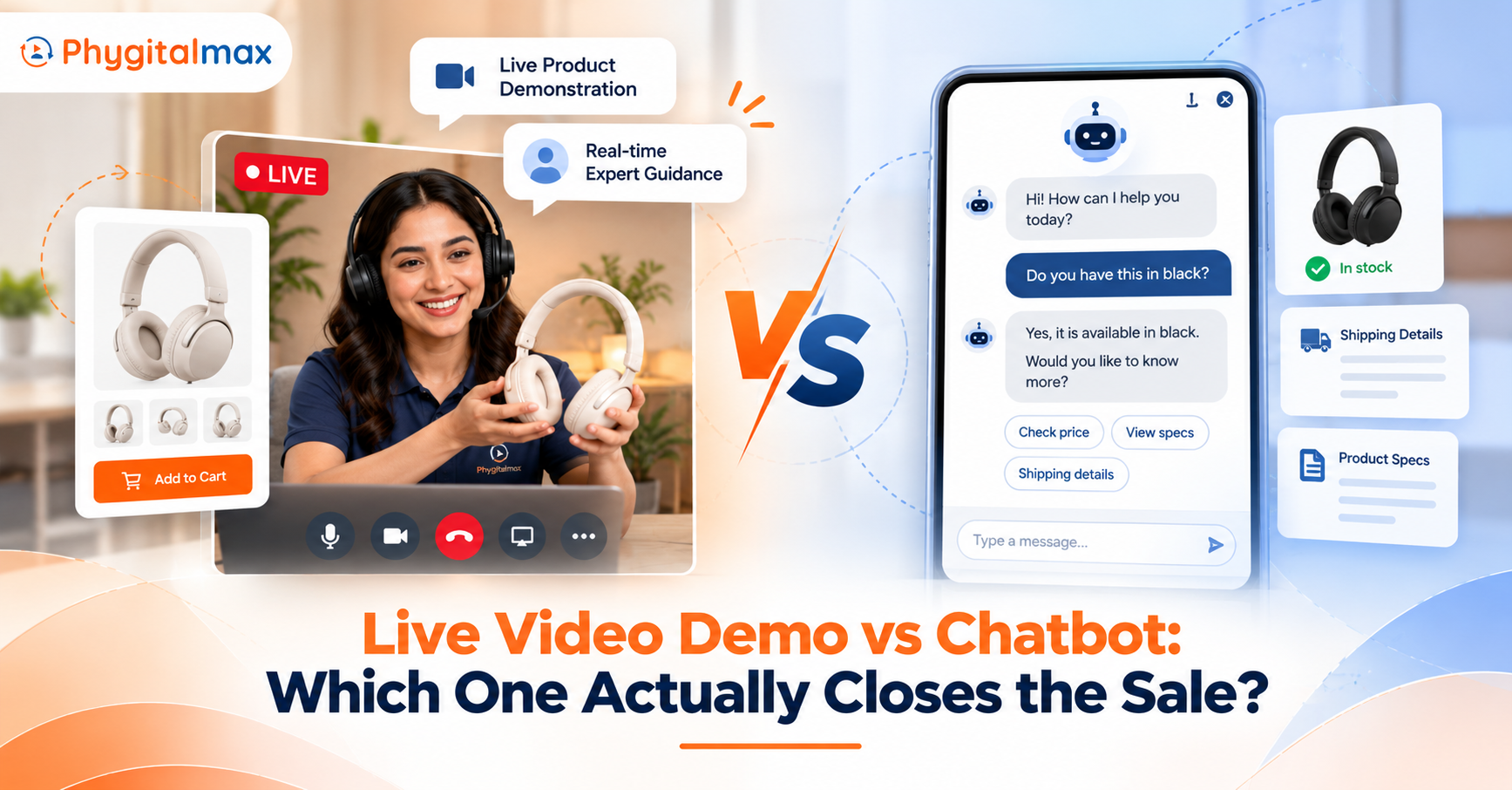
A chatbot answers questions. A live video demo answers the person asking them.
A shopper lands on a product page at 11 pm. She has been comparing two options for a week. She has one nagging doubt about fit, and the chatbot in the corner offers her a menu of five buttons, none of which match.
She leaves. The cart stays full. The doubt wins.
That is the real live video demo vs chatbot question. It is not about which technology is newer. It is about what a buyer needs at the exact moment they are about to say yes or walk away. Sometimes that is a fast answer. Often it is a person who can see what they mean, hear the hesitation in their voice, and respond like a human being.
Live Video Demo vs Chatbot: The Short Answer
A chatbot is best for fast, repeatable, low-stakes questions like order status, store hours or return policy. A live video demo is best when the buyer is high intent and needs guidance, reassurance or proof before spending money, or when a post-purchase problem needs someone who can show, not just tell.
Most brands do not have to choose one. But if you have to pick where a real person adds the most value, it is the moments where trust decides the outcome.

What Chatbots Do Well
Chatbots earn their place, and it helps to be fair about it.
- Speed on simple questions: Order tracking, delivery windows, return policy and store hours need an answer, not a conversation.
- Always available: A chatbot does not sleep, which matters for a shopper browsing late at night.
- Consistent answers: The tenth answer matches the first.
- Lower load on the support team: Repetitive queries stay out of the human queue.
Indian shoppers are also open to automation. In the EY Future Consumer Index (August 2024), 61% of Indian consumers said AI-driven product recommendations are extremely beneficial. Buyers are not anti-technology. They are selective about when they want it.
Where Chatbots Fall Short
The trouble starts when a chatbot is asked to do a human’s job.
Gartner’s 2024 survey of 5,728 customers found that 64% would prefer companies did not use AI in customer service, and 53% would consider switching to a competitor if they found out a company was going to use it. The top concern was that AI would make it harder to reach a person.
A more recent Gartner survey (3,566 customers, February and March 2026) shows the pattern clearly:
- Willing, but not using: 49% said they would have been willing to use a chatbot if the company offered one, yet only 7% used one in their most recent service interaction.
- A short leash: Only 27% would try a chatbot again after a negative experience.
- A human is expected: 87% said access to a human agent is essential when a company uses GenAI in customer service.
Read together, that says buyers will try a chatbot, but one bad exchange can end the relationship with the channel. For a high-value purchase, that is a risky place to leave a customer.
Read more: Why Live Video Commerce Converts Faster Than Traditional Ecommerce
What a Live Video Demo Actually Is
A live video demo puts a real, trained salesperson on the product page, face to face with the shopper, in real time. No app download. No scheduling friction for the customer. The shopper clicks, the person appears, and the conversation starts.
The salesperson shows the product on camera, answers questions as they come up, compares options, and helps the buyer picture it in their own home or life. It is the closest thing e-commerce has to a good store associate walking over and saying, “Let me show you.”
Read more: Live Expert Demonstration on Product Pages
Why a Real Person on Screen Changes the Outcome
A human reads the buyer, not just the question
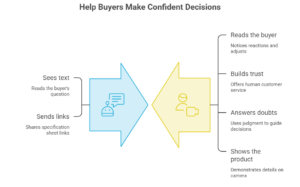
A chatbot sees text. A salesperson sees a customer leaning in, frowning at the price, or going quiet when a feature comes up. They adjust. They slow down, they skip the pitch, they ask a better question.
That is empathy in practice. It is not a script, and it is hard to fake with a decision tree.
Trust is built face to face
The EY India report found that 78% of Indian consumers prefer to shop on platforms that offer human customer service support, and 61% are more inclined to share personal information with a human than with an automated process. When a buyer is about to hand over money and details, who is on the other end matters.
Read more: The Trust Gap: Why Buyers Hesitate at the Final Click
The “I’m not sure” question gets a real answer
The questions that stop a sale are rarely on the FAQ list. “Will this fit my space?” “Is this right for my skin?” “Which of these two would you pick?” These need judgment, and judgment is what an experienced salesperson brings. A live video demo turns a vague doubt into a clear decision, in the moment, while the buyer is still on the page.
Showing beats telling
A chatbot can send a link to a specification sheet. A salesperson can hold the product up to the camera, turn it around, and show the exact detail the shopper asked about. For anything where look, feel, size or setup matters, that difference is large.
Pre-Sales: Live Video Demo vs Chatbot
Before the purchase, the buyer is deciding. This is where a live video demo earns its keep.
- Chatbot role: Answers basic product and delivery questions, collects contact details, points to relevant pages.
- Live video demo role: Guides a high-intent buyer through the choice, handles objections as they appear, and builds confidence to buy.
- Why it matters: A shopper who has already spent time on the page is telling you they are interested. That is the best moment to bring a person in, not another menu.
Read more: 1:1 Live Video Shopping | Cart Abandonment and Live Video Commerce
Post-Sales Support: Live Video Demo vs Chatbot
The sale is not the end. Setup, first use and early problems decide whether a customer comes back or returns the product.
- Chatbot role: Handles order status, warranty questions, return policy and ticket creation.
- Live video demo role: Walks a customer through setup on camera, shows how a feature works, and troubleshoots a problem that is hard to explain in text.
- Why it matters: A customer stuck with a product they cannot set up is not a text problem. Seeing the issue and fixing it together is faster and leaves the customer feeling looked after.
Read more: Live Video Customer Support | Customer Support ROI
The Overall Customer Experience
Digital shopping is efficient, but it can feel cold. Customers get speed and lose warmth. The brands that stand out are the ones that bring the human back without giving up the convenience of online.
That is the phygital idea: the reach and ease of digital, with the presence and care of a person. A chatbot extends the first half. A live video demo delivers the second.
EY India’s research also showed where Indian shoppers feel let down online: damaged goods (21%), inadequate customer support (20%) and obstacles in refunds (19%). Two of those three are support problems, and both are easier to resolve when a real person can see the issue and take ownership.
Read more: Digital Customer Experience: Cold, Real-Time Video | Phygital Commerce Explained
What the India Numbers Say About Live Video Commerce
Live commerce in India is early, and the figures need context.
- A 2021 forecast: RedSeer projected India’s live commerce market to reach USD 4 to 5 billion in GMV by 2025, with fashion expected to contribute 60 to 70%, as reported by YourStory. That is a forecast from 2021, not a measured 2025 result, so treat it as direction, not a current market size.
- Human preference is strong: The EY India figures above (78% prefer human support, 61% more willing to share information with a person) point to the same thing: Indian buyers want a person available.
- Trust is a stated concern: 77% of Indian consumers told EY they are very concerned about data breaches when shopping online. Reassurance from a real person helps here.
One honest gap: there is no independent, public head-to-head study of live video demo conversion against chatbot conversion in India. The case rests on what buyers say they prefer and where they lose trust, not on a single comparison number.
Live Video Demo or Chatbot: How to Decide
Use a chatbot when:
- The question is simple and has one correct answer
- The customer wants speed over conversation
- The topic is routine, like order status or store hours
Use a live video demo when:
- The buyer is high intent and close to a decision
- The product needs showing, explaining or comparing
- The price is high enough that confidence matters
- A support issue is hard to describe in text
- The customer has asked for, or clearly needs, a person
Use both when: the chatbot handles the routine and hands off to a person, visibly and quickly, the moment a buyer needs one. Gartner’s own advice for chatbots is to make them connectors to human support rather than containment traps.
A Person Behind Every Screen: How PhygitalMax Puts a Human on the Page
PhygitalMax is built around one idea: when a buyer is ready to talk, a person should be there.
- Connect Now (always-on): A shopper clicks and reaches a live salesperson right away, while the interest is still fresh.
- Scheduled live demos: For considered purchases, buyers book a time and get a focused one-to-one session.
- One-to-one and one-to-many: A personal walkthrough for a single high-intent buyer, or a live session for a group around a launch or product range.
- Pre-sales and post-sales in one place: The same live video layer helps a buyer choose, then helps a customer set up and get value.
The result is the human connection of a good store, delivered on the product page.
What This Means for the Business
- Better use of high-intent traffic: Visitors who are ready to buy get a person, not a menu.
- Stronger trust at the final click: Face-to-face reassurance reduces second thoughts.
- Smarter support split: Chatbots take the routine load while people handle the moments that decide loyalty.
- A more human brand: Customers remember being looked after, and they say so.
Conclusion
The live video demo vs chatbot debate is not really a contest. Chatbots are good at speed and scale. Live video demos are good at trust, judgment and connection. Customers tell us in survey after survey that they want a person available, especially when money, personal details or a real problem is involved.
If you are choosing where to invest a real salesperson’s time, put them where the decision is made: in front of the high-intent buyer, live, on the page. Let the chatbot handle the rest, and make sure a human is always one click away.
Ready to see it on your own product pages? Book a live demo or talk to our team.
FAQ
Q: What is the difference between a live video demo and a chatbot?
A: A chatbot is an automated tool that answers questions in text, usually from a fixed set of responses. A live video demo connects the shopper face to face with a real salesperson who shows the product and responds in real time.
Q: Is a live video demo better than a chatbot for sales?
A: For high-intent buyers and higher-value products, a live video demo is usually the stronger fit because a person can show the product, read hesitation and build trust. Chatbots work better for simple, repeatable questions.
Q: Do customers prefer human support or chatbots?
A: Research leans toward humans for anything that matters. Gartner found 64% of customers would prefer companies did not use AI in customer service (2024), and EY India found 78% of Indian consumers prefer to shop on platforms with human support (2024). Many are still open to chatbots for simple tasks.
Q: Can a chatbot and a live video demo work together?
A: Yes. A chatbot can handle routine queries and hand off to a live salesperson when a buyer needs help or shows buying intent. The handoff should be quick and visible.
Q: When should a brand use a live video demo instead of a chatbot?
A: Use a live video demo when the buyer is close to deciding, the product needs showing or comparing, the price makes confidence important, or a support issue is hard to explain in text.
Q: Can live video demos help after the sale?
A: Yes. A live video session can walk a customer through setup, show how a feature works and troubleshoot problems on camera, which supports post-sales support and customer satisfaction.
Q: Is live video commerce growing in India?
A: A 2021 RedSeer forecast, reported by YourStory, projected India’s live commerce GMV at USD 4 to 5 billion by 2025. That was a projection, not a confirmed result.