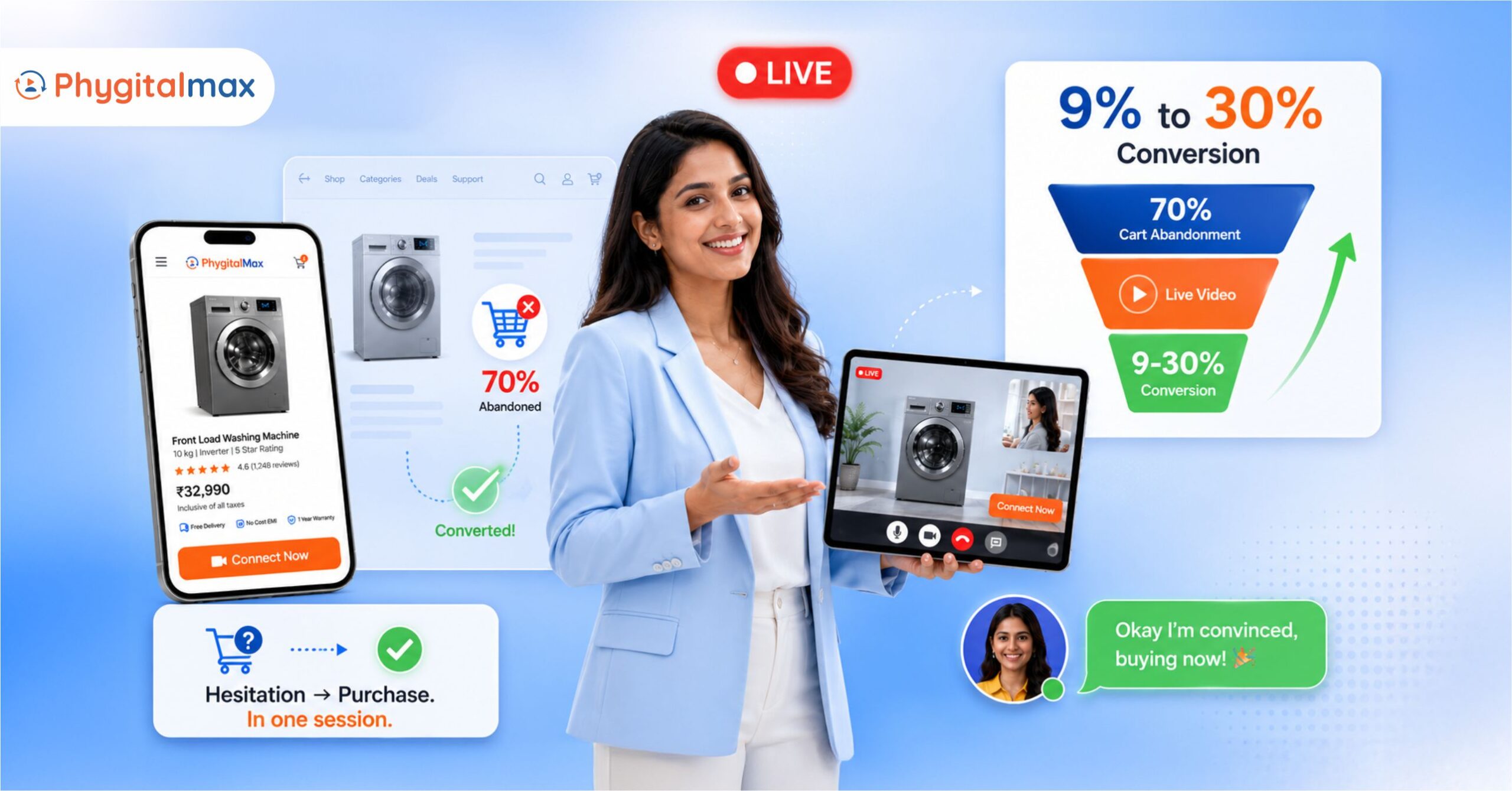
How phygital live commerce is helping Indian D2C and FMCD brands convert the 70 percent of shoppers who add to cart but never complete their purchase.
A shopper lands on your product page. They read the description. The price looks right. It goes straight into the cart.
And then they disappear.
This is not a rare scenario. It is the default outcome for 70 percent of all ecommerce shopping sessions globally. The average cart abandonment rate sits at 70.22 percent worldwide, and on mobile, it rises to 85.65 percent, according to ZeroCart AI’s Cart Abandonment Statistics 2026. Since over 70 percent of Indian ecommerce traffic arrives on mobile, this number directly defines how most Indian brands are performing today.
Every brand running ecommerce knows the pain of the abandoned cart. Most are treating the wrong problem. This guide breaks down the real cart abandonment reasons and explains how phygital live video commerce solves them at the source.
What Is Cart Abandonment and What Is the Average Cart Abandonment Rate in India?
Cart abandonment in ecommerce occurs when a shopper adds one or more items to their online shopping cart but exits the session before completing the purchase. The cart abandonment rate is calculated as:
Cart Abandonment Rate = (1 minus Completed Purchases divided by Initiated Checkouts) x 100
At a global average of 70.22 percent, this means for every 100 shoppers who show enough intent to add a product to their cart, only 30 actually buy. For Indian D2C brands specifically, the conversion gap is even sharper. Most D2C brands in India convert at just 2 percent of total site traffic, while Amazon and Flipkart convert at around 10 percent, according to Razorpay’s Cart Abandonment Rate analysis.
For a brand doing Rs. 50 lakh in monthly revenue, a 70 percent abandonment rate means over Rs. 1 crore in potential revenue is being lost every single month to visitors who showed clear purchase intent but did not convert. Cart abandonment is not a minor leak. It is the largest single revenue gap in most ecommerce businesses.
Cart Abandonment Reasons: Why Indian Shoppers Leave Without Buying
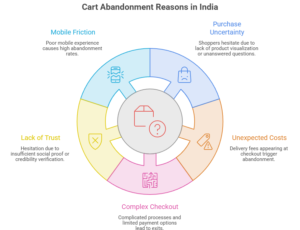
Before any cart abandonment solution can work, it helps to understand what is actually driving shoppers out. The cart abandonment reasons in India fall into five consistent patterns.
1. Purchase Uncertainty and Hesitation
The most underaddressed cause of cart abandonment is not price. It is uncertainty. A shopper who cannot fully visualise a product in their own context, or who has a specific question they cannot quickly get answered, will pause. That pause almost always becomes an exit. Baymard Institute’s research confirms purchase uncertainty as the primary driver behind the global 70.19 percent abandonment rate. For high-consideration products like electronics, appliances, jewellery, and skincare, this hesitation is significantly compounded.
2. Unexpected Costs at Checkout
The most common shopping cart abandonment trigger in India is a delivery charge that appears only at checkout. A Rs. 49 to Rs. 99 delivery fee the buyer did not see earlier triggers abandonment at 35 to 40 percent among price-sensitive segments, according to Shiprocket Checkout’s Cart Abandonment Statistics 2025. Transparency about costs early in the buying journey is essential to keeping shoppers in the funnel.
3. Complex Checkout and Limited Payment Options
22 percent of cart abandonments are caused by a complicated checkout process. A further 13 percent leave when their preferred payment method, whether UPI, net banking, wallets, or COD, is not available. In a market as payment-diverse as India, checkout friction is a direct and measurable abandonment driver.
4. Lack of Trust and Social Proof
First-time buyers, particularly in tier 2 and tier 3 cities where over 66 percent of new Indian D2C orders now originate, face higher trust barriers. Without visible social proof, a responsive support channel, or a way to verify the brand’s credibility in real time, hesitant shoppers exit. Trust badges and visible return policies can reduce cart abandonment by up to 28 percent, but they do not resolve the buyer’s actual product question.
5. Mobile Experience Friction
Over 70 percent of Indian D2C brand traffic arrives on mobile, yet most product pages are still designed around a desktop experience. Small text, slow load times, and difficult navigation compound the abandonment rate for the vast majority of Indian ecommerce visitors. Mobile cart abandonment in India hits 85.65 percent, making mobile optimisation the single highest-leverage conversion lever most brands are still underusing.
Why Traditional Ecommerce Conversion Rate Optimization Is Not Enough
The standard ecommerce conversion rate optimization playbook looks like this: better product photography, faster load times, A/B tested checkout flows, retargeting ads, abandoned cart recovery emails, and exit-intent pop-ups with discount codes.
These tools have a place. But they all share a structural problem. They are reactive. They engage the buyer after they have already left. By that point, the shopper has either found the product elsewhere, lost the purchase impulse, or is waiting for a discount that trains them never to buy at full price. Swell’s Cart Abandonment Statistics note that only 5 to 11 percent of abandoned cart recovery emails result in a completed sale.
The bigger issue is that none of these tactics address the root cause of most abandonments. The buyer had a question they could not get answered. They were uncertain about the product. A discount code does not answer the question. An email does not demonstrate the product in real conditions. A retargeting ad does not build the confidence a hesitant buyer needs to commit.
Improving ecommerce conversion rate optimization at the checkout level moves the needle by fractions. The real conversion opportunity is earlier in the session, on the product page itself, before the hesitation becomes an exit.
Read more: Live Shopping vs Traditional Ecommerce: Which One Wins in 2026?
How to Reduce Cart Abandonment with Phygital Live Commerce
Phygital commerce combines the human guidance and trust of physical retail with the convenience and reach of digital. Instead of letting a high-intent buyer sit alone on a product page with unanswered questions, phygital live commerce puts a real product expert in front of them at the exact moment they need it.
According to Firework’s research on video commerce and cart abandonment, product pages featuring interactive live video elements see up to a 39 percent increase in cart conversions. Landing pages with live or shoppable video can boost conversion rates by as much as 80 percent.
The mechanism is direct. When a buyer can ask “does this refrigerator fit a standard Indian kitchen counter?” and get an immediate live demonstration from a product expert, the hesitation that would have caused abandonment is resolved before it becomes a lost sale. The buyer completes their purchase inside the session, not in a follow-up email two days later, if at all.
Live commerce converts at 9 to 30 percent compared to 2 to 3 percent for traditional ecommerce, according to Opensend’s Live Stream Conversion Rate Statistics. In 1:1 phygital sessions for premium categories, conversion rates reach 40 to 70 percent. That is not a marginal improvement from ecommerce conversion rate optimization. It is a structural shift in how buying decisions are made.
Read more: How Live Video Commerce Converts Faster Than Traditional Ecommerce
The PhygitalMax Approach: Live Expert Access on Every Product Page
Most live commerce tools push brands toward separate livestream platforms or social media shopping events. PhygitalMax takes a fundamentally different approach to shopping cart abandonment solutions.
PhygitalMax embeds phygital live commerce directly on the brand’s own product page. When a shopper lands and hesitates, they see two clear options right there: Connect Now to start a live video session immediately with a product expert, or Schedule to book a session at a time that works for them.
The expert answers the buyer’s specific question live, demonstrates the product in real conditions, and the purchase happens within the same session. No redirects, no new tab, no friction. What would have become an abandoned cart is converted into a confident, completed sale.
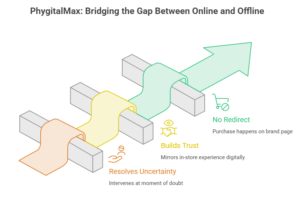
1. Resolves Purchase Uncertainty Before It Becomes Abandonment
Instead of chasing the buyer after they leave, PhygitalMax intervenes at the exact moment of doubt on the product page itself. Every high-intent visitor gets a live commerce option before they have a reason to exit.
2. Builds Real-Time Trust for First-Time Buyers
For tier 2 and tier 3 city buyers making their first high-value ecommerce purchase, a live expert on screen is the most powerful trust signal available. It mirrors the in-store experience they already know, delivered digitally.
3. No Redirect, No Platform Switch
The purchase happens inside the live session on the brand’s own product page. There is no checkout friction, no new tab, no external platform. The buyer stays in one place from first impression to completed order.
Read more: 5 Live Commerce Strategies That Instantly Improve Your Ecommerce Conversion Rate
Live Commerce in India: What the Numbers Show
Live commerce in India is not a future trend. It is an active, high-growth revenue channel right now. The India live commerce market was valued at $7.04 billion in 2025 and is projected to grow at a CAGR of 44.81 percent through 2034, according to IMARC Group’s India Live Commerce Market Report.
For D2C and FMCD brands competing against Amazon and Flipkart’s 10 percent conversion rates, live commerce is the most direct route to closing the gap. The data is consistent:
- Standard ecommerce conversion rate: 2 to 3 percent
- Live commerce session conversion rate: 9 to 30 percent
- 1:1 phygital live video (premium categories): up to 70 percent
- Increase in cart conversions from interactive video on product pages: 39 percent
- Abandoned cart recovery email success rate: 5 to 11 percent
- Phygital brands grow 2.5 times faster than single-channel competitors (BCG)
The brands investing in phygital live commerce now are not just recovering abandoned carts. They are preventing abandonment from happening at all.
Frequently Asked Questions About Cart Abandonment and Phygital Commerce
Q: How to reduce shopping cart abandonment rates in ecommerce?
The most effective way to reduce shopping cart abandonment rates is to resolve purchase uncertainty before the buyer leaves the product page. This means giving high-intent shoppers access to a live product expert via phygital live video, where they can get their specific question answered in real time and complete the purchase without hesitation. Supporting tactics include transparent pricing from the first product page view, multiple payment options including UPI and COD for Indian buyers, and a streamlined mobile checkout experience.
Q: What are the most effective cart abandonment solutions for D2C brands in India?
For Indian D2C brands, the most effective cart abandonment solutions combine proactive and reactive approaches. Proactively, embedding live video commerce on product pages prevents abandonment by resolving doubt in real time. Reactively, abandoned cart recovery email sequences, retargeting ads, and SMS reminders recover a portion of those who still exit, though recovery rates typically range from only 5 to 11 percent. The highest ROI comes from preventing the abandonment in the first place using phygital commerce.
Q: What is the average cart abandonment rate in ecommerce?
The global average cart abandonment rate in ecommerce is 70.22 percent in 2026. On mobile devices it rises to 85.65 percent, and on tablets to 80.74 percent. For Indian D2C brands, where over 70 percent of traffic arrives on mobile and conversion rates sit at just 2 percent of total traffic, the effective abandonment impact is even higher than the global average suggests.
Q: What is phygital commerce and how does it help ecommerce conversion rate optimization?
Phygital commerce combines the human connection and trust of physical retail with the scale and convenience of digital commerce, typically delivered via live video embedded on the product page. For ecommerce conversion rate optimization, phygital commerce is the most direct solution to purchase hesitation, which drives the majority of cart abandonments. Instead of optimising buttons, layouts, and checkout flows, phygital commerce addresses the buyer’s actual need: a real person to help them make a confident decision.
Q: What is live commerce and how is it different from regular ecommerce?
Live commerce is a real-time video-based shopping format where a buyer connects with a product expert, sees the product demonstrated live, asks questions, and completes the purchase inside the session. Unlike regular ecommerce, which is a static, self-service experience, live commerce is interactive, personalised, and guided. It converts at 9 to 30 percent versus 2 to 3 percent for traditional ecommerce, making it the highest-converting digital commerce format available to brands today.
Conclusion
Cart abandonment is not a checkout problem. It is a confidence problem. And the answer is not a better discount code, a more aggressive retargeting sequence, or another round of ecommerce conversion rate optimization on the checkout flow.
It is a live product expert, available on the product page, at the exact moment a buyer is deciding whether to trust you with their money.
Phygital live commerce gives every high-intent shopper that option. Connect with an expert now or schedule for later. Get the question answered. Complete the purchase inside the session. No hesitation, no abandoned cart, no recovery email needed.
That is how forward-thinking Indian D2C and FMCD brands are closing the gap between a 70 percent abandonment rate and the revenue their traffic should already be generating.
Ready to convert your cart abandonments into completed sales? Book a live demo with PhygitalMax and see phygital live commerce in action on your product pages.