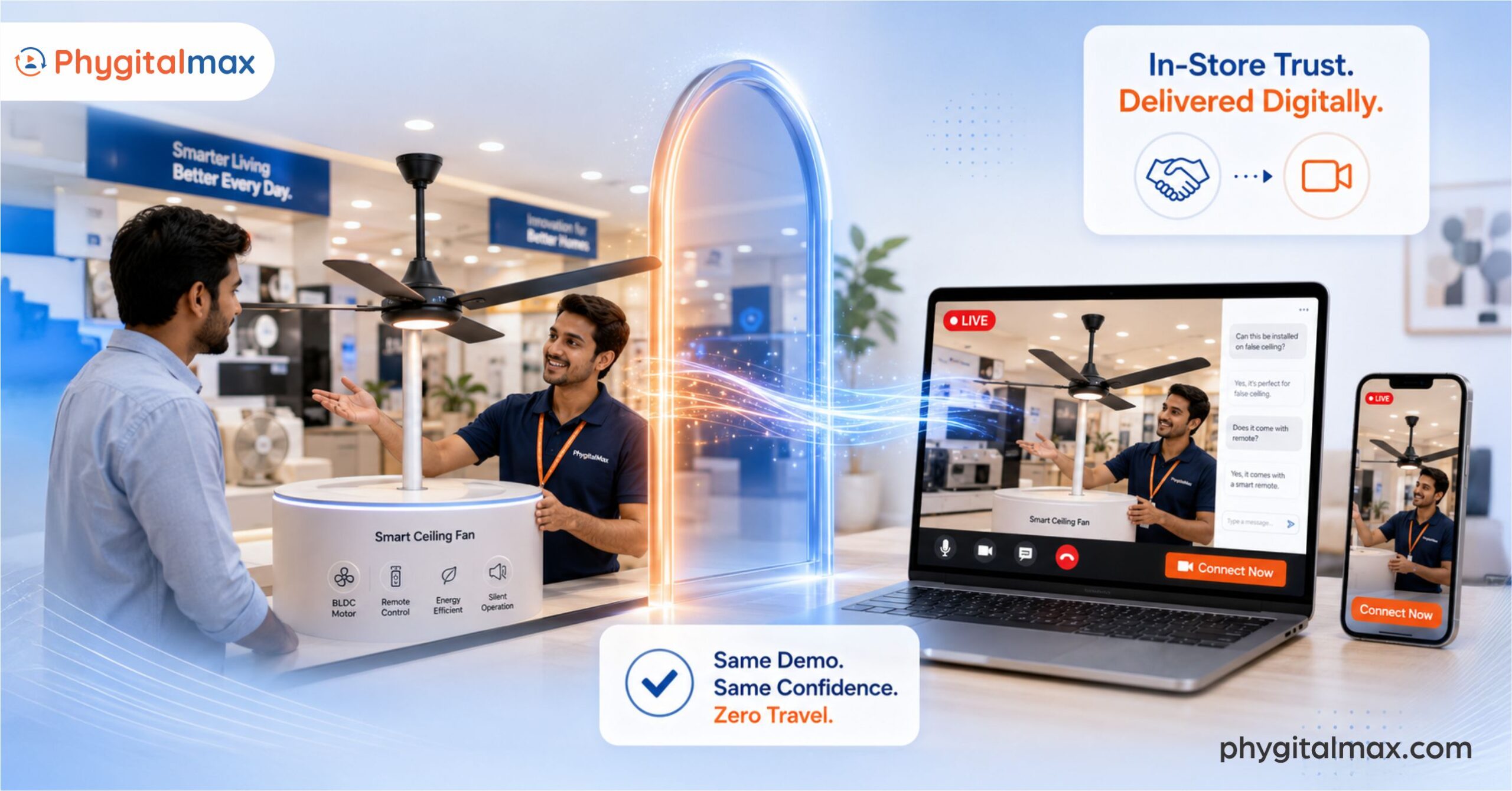
What phygital commerce really means, why static ecommerce cannot replicate the confidence of an in-store visit, and how live video is closing that gap for D2C and FMCD brands.
Think about the last time you bought something in a physical store, something that mattered. You picked it up. You asked the salesperson a question. You watched it work. You walked out feeling certain.
Now think about the last time you bought something online. You scrolled some photos. You read a description written by someone else. You clicked buy, hoping it would be what you expected.
That gap between those two experiences is exactly what phygital commerce exists to close.
What Is Phygital Commerce? A Clear Definition
Phygital commerce is the meaning behind blending “physical” and “digital” into a single experience. But the real definition is not about brands running stores alongside a website. It is about recreating the trust, satisfaction, and confidence of an in-store visit, entirely through digital means, so a buyer sitting at home gets the same experience they would get standing in a showroom.
In a true phygital model, a shopper does not need to travel anywhere. They connect with a real product expert through live video, watch the product actually working in real time, ask the exact question they have, and get a real answer instantly. It is the in-store demo, the salesperson’s reassurance, and the confidence of seeing something work with your own eyes, delivered digitally, from wherever the buyer already is.
This is different from simply being present on multiple channels. Omnichannel means a brand exists on a website, an app, and maybe a store. Phygital commerce means the digital experience itself carries the trust and human guidance that used to only exist inside a physical store.
Why Static Ecommerce Cannot Replicate the In-Store Feeling
Purely digital ecommerce has a structural weakness. It converts at 2 to 3 percent globally because a static product page cannot resolve a buyer’s specific doubt in real time, and it cannot show a product actually working the way a demo in a store can.
A shopper unsure whether a fan will actually reduce their electricity bill, or whether a kitchen appliance is as quiet as the listing claims, has no one to ask and nothing real to watch. In a store, a salesperson would switch it on right there. Online, the buyer either takes a chance or abandons the purchase entirely.
Phygital commerce closes this gap by putting that same live demonstration and real human reassurance directly into the digital buying journey, at the exact moment the buyer needs it, without requiring them to be anywhere near a physical location.
Read more: Live Shopping vs Traditional Ecommerce: Which One Wins in 2026?
Bringing the Showroom Experience Home
Consumer appliance brands are a strong example of where this matters most. A buyer deciding on a smart fan or a kitchen appliance usually wants to see it running, hear how it sounds, and get a direct answer about power savings or installation before they commit.
Atomberg, a leading appliance brand, has used live video commerce to give online buyers that exact experience. Instead of leaving shoppers to decide from photos and specs alone, buyers can connect with a real expert, watch the product demonstrated live, and get their specific questions answered before purchasing, the same certainty they would get walking into a store, just delivered from their phone or laptop.
This is what phygital commerce actually means in execution. Not a brand opening more locations. A brand making its digital experience feel as trustworthy as its physical one.
Live Video: How Phygital Commerce Gets Delivered Digitally
Live video commerce is the mechanism that makes this possible at scale. It puts a real human expert directly on a brand’s existing product page. Instead of reading static specifications alone, a shopper connects with an expert who demonstrates the product, answers questions, and guides the decision in real time, exactly what a good in-store associate would do, just delivered through a screen instead of a showroom floor.
There is no store to build, no lease, no staffing across cities. Just the same human layer of trust that a physical location would offer, delivered through video, embedded on the same page where the buyer is already deciding.
Live commerce sessions convert at 9 to 30 percent, compared to 2 to 3 percent for standard ecommerce. In premium and high-consideration categories, 1:1 live video sessions push conversion as high as 70 percent, the kind of confidence typically reserved for in-person selling.
Read more: How Live Video Commerce Converts Faster Than Traditional Ecommerce
The PhygitalMax Approach: The In-Store Experience, Built Into the Product Page
PhygitalMax is built specifically around this idea. Phygital commerce should not require a brand to build physical infrastructure. It should be embedded directly into the digital experience the brand already has.
On any product page using PhygitalMax, shoppers see two options: Connect Now to start a live video session with a product expert immediately, or Schedule to book a session for a preferred time. The expert demonstrates the product working, answers the buyer’s specific doubts, and the purchase happens within the same session. No redirect, no separate app, no visit to a physical store required.
This model works especially well for FMCD, electronics, and appliance brands, categories where a buyer’s confidence hinges on seeing a product in action or having it explained before they commit. It gives brands the trust advantage of an in-store visit without the buyer ever having to leave their home.
Read more: 5 Live Commerce Strategies That Instantly Improve Your Ecommerce Conversion Rate
Read more: Why FMCD and Electronics Brands Are Using Live Video to Cut Product Returns by 40%
The Business Case: What Phygital Commerce Delivers
Brands that successfully replicate in-store trust digitally consistently outperform brands relying on static ecommerce alone. This pattern holds across categories, from appliances and electronics to beauty and fashion.
Benefits that show up consistently once brands adopt this model:
- Higher conversion rates, because purchase hesitation gets resolved in real time with a live demonstration rather than left unanswered
- Lower return rates, because buyers see the product actually working and form accurate expectations before they buy, not after
- Stronger brand trust, because a live human presence builds the same confidence a store visit would, without the buyer needing to travel
- Faster reach without the years-long timeline of physical expansion, since the experience scales digitally while still carrying a human touchpoint
For FMCD and appliance brands specifically, where buyers are already used to seeing a demo before purchasing in a physical retail environment, phygital commerce is less a new concept and more a direct digital translation of a buying habit that already exists.
Frequently Asked Questions About Phygital Commerce
Q: What is the meaning of phygital commerce?
Phygital commerce means recreating the trust and experience of an in-store visit through digital means. Rather than brands simply operating both physical stores and a website, phygital commerce uses tools like live video to give online buyers the same confidence, live demonstrations, and real answers they would get standing in front of a product in a store, without requiring them to leave home.
Q: How is phygital commerce different from omnichannel retail?
Omnichannel retail means a brand is present across multiple channels, such as a website, app, and physical store. Phygital commerce goes further by making the digital experience itself carry the trust and human guidance typically associated only with physical retail, most commonly through live video demonstrations embedded directly into the online buying journey.
Q: What are some real examples of phygital commerce in action?
A clear example is an appliance brand like Atomberg using live video commerce so online buyers can watch a product actually working, ask direct questions, and get real answers before purchasing, replicating the confidence of an in-store demo entirely online. This is different from a brand simply having both a store and a website; it is about making the digital channel itself deliver that same in-person trust.
Q: What are the benefits of phygital commerce for D2C and FMCD brands?
The benefits include higher conversion rates from real-time purchase guidance, lower product return rates from accurate pre-purchase expectations, stronger brand trust from live human interaction, and the ability to deliver an in-store-quality experience without the cost or timeline of physical expansion.
Q: Do you need physical stores to build a phygital commerce strategy?
No. Live video commerce delivers the core benefit of phygital commerce, in-store-level trust and guidance, entirely through digital infrastructure. Platforms like PhygitalMax embed live video experts directly on existing product pages, giving brands a full phygital experience without any physical retail investment.
Conclusion
Phygital commerce is not about running stores alongside a website. It is about making sure a buyer sitting at home gets the same certainty they would get standing in a showroom, watching a product work, asking their real question, and getting a real answer before they decide to buy.
Brands like Atomberg are already proving this works, not by opening more locations, but by bringing the in-store demonstration directly into the digital buying journey through live video.
That is the model PhygitalMax makes possible for any FMCD or electronics brand. No stores to open, no infrastructure to build. Just a live expert, one tap away, on every product page that needs one.
Ready to bring the in-store experience to your product pages? Book a live demo with PhygitalMax and see how it works.