
Digital customer experience has never been faster. It has also never felt less human. Real-time video closes that gap without giving up speed.
Digital customer experience is every interaction a customer has with a brand through a screen, from searching and browsing to buying and asking for help. Over the last decade, brands made those interactions faster: instant search, one-tap checkout, chatbots that reply in seconds. What most of them did not make was warmer. A customer can now complete a purchase, or file a complaint, without ever feeling that a person exists behind the brand.
That is the cold spot in modern digital customer experience, and it is where customer engagement quietly drops.
Why Digital Customer Experience Feels Cold
Most digital journeys were designed for speed and scale. They work well for the average customer asking the average question. The trouble is that real customers rarely ask the average question. They want to know whether this model fits their space, why their setup is failing, or which option suits their situation. A flow built for everyone cannot answer a question that only one person has.
The data supports this. In PwC’s 2025 Customer Experience Survey, 86% of consumers said human interaction is moderately or very important in their brand experience. The same survey found that 58% are only somewhat or not at all comfortable using AI tools to engage with brands, and that pressure to adopt AI often comes more from internal ambition than customer demand. Automation works for tracking an order. It struggles where judgment and empathy matter: choosing a product, resolving a doubt, fixing a problem.
The coldness shows up in three places. On the product page, there is no one to ask. At checkout, a last-minute doubt has nowhere to go. After the purchase, support means a ticket queue or a scripted chat that cannot see the problem.
Read more: Personalized CX Without a Website Overhaul: Yes, It’s Possible
Why Chat, FAQs, and Self-Service Cannot Warm It Up Alone
Text chat, help centers, and FAQs are one-way channels. The customer cannot show the product or the problem, and the agent cannot see either. The result is a long back-and-forth, repeated explanations, and low first-contact resolution. Customers describe the issue three times and still feel unheard.
Real-time video adds what text cannot: a face, a voice, and a shared view of the product or problem. It is also one of the more practical customer engagement strategies because it turns a passive visit into a live conversation at the moment of need. McKinsey’s research on live commerce makes a related point, noting that live formats shorten the customer decision journey from awareness to purchase. That same shortening applies when a support question gets answered on the spot instead of overnight.
Read more: Why 1:1 Live Video Is the Future of Online Shopping
How PhygitalMax Puts a Human Face on Digital Customer Experience
PhygitalMax adds a live video layer to the website or app a brand already runs. A customer taps Connect Now to reach a real person immediately, or uses Schedule to book a session when it suits them. Co-browsing lets the agent look at the same page the customer sees, chat support runs alongside the call, and no app installation is required. Customers can also invite friends or family into the session, which matters for purchases decided by more than one person.
In sales
Live video turns a product page into guided selling. A product expert walks the customer through the product, answers the specific question a spec sheet cannot, and adapts the conversation to the customer’s situation. That is a far more personalized shopping experience than recommendation widgets, and it gives the customer the demo before they buy. It also opens natural room for cross-sells and upsells, because the agent understands the actual need. For the confidence side of this, see The Trust Gap: Why Buyers Still Hesitate at the Final Click.
In support
For tech support, troubleshooting, and service queries, the agent can see the issue instead of guessing at it. Customers feel more valued when there is a face behind the name, and that tends to show in satisfaction and loyalty metrics such as CSAT and NPS. The same layer extends to field support, where remote inspections and documentation happen before a technician is dispatched, and to back-end support teams that give customers visual assistance and raise first-time resolution. Support conversations can also become sales conversations, which is covered in From Tickets to Transactions: How to Maximize Customer Support ROI and Reduce FMCD Product Returns with Live Video Customer Support.
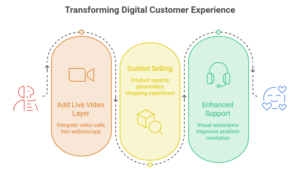
What This Means for the Business
- Customer engagement rises because customers get a live answer at the moment of need, which is real time customer engagement rather than a reply hours later
- Sales and support stop being separate silos, since the same video layer handles pre-purchase questions and post-purchase problems
- Satisfaction metrics such as CSAT and NPS have a clear lever, because a face and a live resolution change how customers rate the interaction
- First-contact resolution improves when the agent can see the problem, which cuts repeat contacts and ticket volume
- The brand gets an omnichannel customer experience in practice, with the attention of an in-store conversation available on any product page
Conclusion
Digital customer experience does not feel cold because brands lack technology. It feels cold because the technology removed the people at the exact moments customers wanted them. The fix is not less automation. It is adding a live human option where judgment, trust, and clarity matter most, in both sales and support. Real-time video does that without a website rebuild and without an app download.
Ready to add a human face to your digital customer experience? Book a live demo with PhygitalMax and see how it works.
Frequently Asked Questions
Q: What is digital customer experience?
A: Digital customer experience is the sum of a customer’s interactions with a brand through digital channels such as websites, apps, chat, and email, covering discovery, purchase, and support.
Q: Why does digital customer experience feel impersonal?
A: Most digital journeys are built for speed and scale, so they answer predictable questions well but give customers no way to talk to a person when their situation is specific or unclear.
Q: How can brands increase customer engagement online?
A: Combine self-service with a live human option. Live video lets customers ask questions, see the product, and get answers in the moment, which keeps them in the journey instead of leaving to search elsewhere.
Q: Can live video be used for customer support as well as sales?
A: Yes. The same video layer supports pre-purchase guided selling and post-purchase help such as troubleshooting, remote inspections, and visual assistance, so one setup serves both teams.
Q: Does live video replace chatbots and self-service?
A: No. Chatbots and self-service handle routine questions quickly. Live video takes over where the question is complex, emotional, or specific, so the two work together as one omnichannel customer experience.