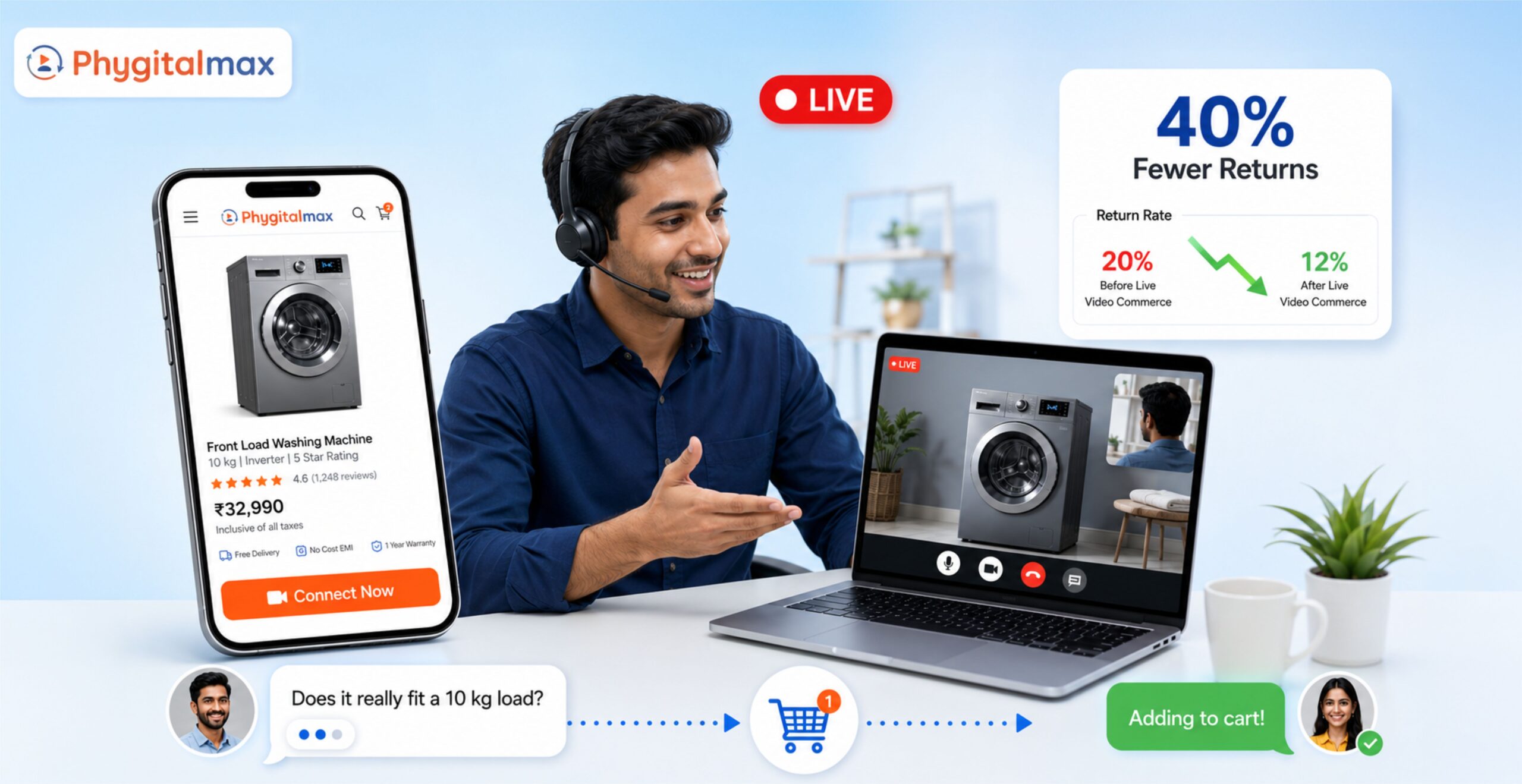
How real-time video demos are helping India’s FMCD and consumer electronics brands cut ecommerce return rates by up to 40 percent and protect margins in 2026.
A customer in Bengaluru orders a 55-inch QLED TV online during a sale. It arrives in two days, gets unboxed, set up, and returned within 48 hours. Not because it was defective. Because the colour accuracy “looked different from the listing.”
This is not a rare edge case. It is the everyday profit leak that FMCD and consumer electronics brands selling online quietly absorb, season after season.
Product returns are not just a logistics headache. They are a communication failure. And live video commerce is proving to be the most effective fix the industry has found yet.
The Product Return Crisis Hitting Indian Electronics Brands
India’s ecommerce market crossed $65 billion in GMV in 2025, growing at 19 to 21 percent annually, according to Bain and Company’s How India Shops Online 2026. That growth is exciting. What is less talked about is the returns problem sitting underneath it.
A staggering 81 percent of Indian online shoppers returned a purchase in the past year, far ahead of 48 percent in the US and 54 percent in Germany. The Indian ecommerce environment makes this worse. Cash-on-delivery orders, which still dominate large parts of India, carry 3 to 4 times higher return rates than prepaid transactions, because some buyers place exploratory orders with no firm intent to keep the product.
For FMCD categories specifically, the numbers are punishing. Consumer electronics and home appliances see online return rates between 10 and 25 percent depending on the product category and platform, as tracked by TrackVid’s Ecommerce Return Statistics 2026. A single returned washing machine or refrigerator, once you account for reverse logistics, inspection, repackaging, and resale at a markdown, can erase the margin on three to five successful orders.
The India live commerce market is valued at $7.04 billion in 2025 and is projected to grow at a CAGR of 44.81 percent through 2034, according to IMARC Group’s India Live Commerce Market Report. The brands already in this space are not just chasing conversion. Many are finding their returns problem is quietly solving itself.
Why Electronics Products Get Returned (The Root Cause Is Not What You Think)
Most brands assume returns happen because of defects or incorrect specifications. Research consistently tells a different story.
Over 45 percent of ecommerce returns trace back to unmet expectations, as reported by Richpanel’s Ecommerce Return Rates 2026 analysis. The product looked, felt, or performed differently from what the buyer imagined based on static images and descriptions. For electronics and appliances, this plays out in very specific ways.
- The television whose colour mode looked completely different under room lighting compared to the studio-lit product photo
- The split AC whose outdoor unit size made sense in centimetres but felt wrong once the installation team arrived
- The laptop whose keyboard travel only became a problem when the buyer typed on it for the first time after delivery
- The dishwasher that was quieter in the product listing video than it turned out to be in an actual kitchen
None of these are defect returns. These are expectation returns. And no amount of additional spec bullet points or 360-degree product images fully closes this gap, because the buyer is still forming a mental model in isolation.
This is the communication failure that live video directly resolves.
How Live Video Commerce Fixes the Root Cause of Returns
Live shopping purchases consistently show 40 to 50 percent lower return rates than traditional ecommerce purchases. The reason is direct: when a buyer watches a real expert demonstrate a product in actual conditions, they form an accurate mental picture of what they are buying before they click purchase.
According to Channelwill’s Ecommerce Return Rates research, product videos alone reduce returns by up to 35 percent. Live, interactive video sessions go further because they are personalised. A buyer watching a television demo can ask the expert to switch to a dark scene to check black levels. A buyer looking at a washing machine can ask about cycle noise during a live walkthrough.
This interactivity is what makes live video a different category of tool from better product photography or longer descriptions. The buyer is not a passive observer. They are getting the product explained in direct response to their specific doubts, in real time, before the order is placed.
Read more: How Live Video Commerce Converts Faster Than Traditional Ecommerce
Read more: Live Commerce Strategies That Instantly Improve Your Ecommerce Conversion Rate
The PhygitalMax Approach: Live Video Embedded on the Product Page Itself
Most live commerce solutions rely on separate livestream platforms or social media events. PhygitalMax takes a different approach by embedding live video directly into the product page on the brand’s website.
When shoppers visit a product page, they can either Connect Now to speak with a product expert instantly or Schedule a session at their convenience. The expert demonstrates the product live, answers questions, and guides the customer without them ever leaving the page.
The experience continues even after the purchase, with customers able to connect to product experts over live video for installation support, feature guidance, troubleshooting, and product-related queries.
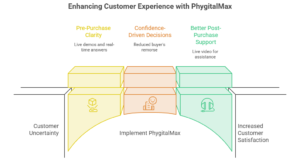
This approach solves three key challenges for FMCD and electronics brands:
1. Pre-Purchase Clarity
Live product demonstrations and real-time answers help customers understand complex products and make informed buying decisions.
2. Confidence-Driven Purchase Decisions
A buyer who has seen a product demonstrated live and had their specific questions answered is far less likely to experience buyer’s remorse. Their expectations align with the product they receive, leading to better purchasing decisions and increased trust in the brand.
3. Better Post-Purchase Support
Customers can reconnect with product experts through live video for setup assistance, troubleshooting, and feature guidance, leading to faster issue resolution, higher customer satisfaction, and stronger brand loyalty.
Why This Is the Right Moment for India’s FMCD Brands
India’s live commerce market is growing faster than almost any other digital commerce segment globally, at a 44.81 percent CAGR projected through 2034. The country has over 800 active D2C brands across electronics, home appliances, beauty, and apparel, with tier 2 and tier 3 cities now contributing 66 percent of new D2C orders in FY26, according to Mordor Intelligence’s India D2C Ecommerce Market Report.
These are buyers who are shopping online for the first time for electronics at high price points. They do not have the comfort level of a metro shopper who has returned five products and knows the process. For them, a live video session with a product expert before purchase does two things simultaneously: it reduces their purchase hesitation and it protects the brand from a return driven by mismatched expectations.
The Richpanel ecommerce return analysis notes that for high-consideration products like electronics, live commerce consistently pushes return rates from the 15 to 25 percent category range down to 10 to 15 percent. For a brand moving hundreds of units monthly in categories like ACs or refrigerators, that gap directly affects profitability.
Read more: Live Shopping vs Traditional Ecommerce: Which One Wins in 2026?
Frequently Asked Questions About Product Returns and Live Video Commerce
Q: What is the average product return rate for electronics ecommerce in India?
Consumer electronics return rates in India range from 10 to 25 percent depending on the product category and platform. High-value categories like televisions, laptops, and large appliances tend to sit at the higher end of this range. Cash-on-delivery orders inflate return rates by 3 to 4 times compared to prepaid orders, making this a structurally important issue for Indian FMCD brands.
Q: How does live video commerce reduce product returns?
Live video gives buyers an accurate, real-time view of a product in actual use conditions before they purchase. This closes the expectation gap that drives the majority of ecommerce returns. When buyers see a product demonstrated live and get their specific doubts answered before placing an order, their post-delivery experience matches their expectations, removing the primary trigger for returns.
Q: Does PhygitalMax work for brands with their own D2C website or only on marketplaces?
PhygitalMax is built specifically for brands with their own D2C website or ecommerce store. The live video widget embeds directly on the product page, so the entire session, from demonstration to purchase, happens on the brand’s owned platform. Buyers connect instantly or schedule a session, without leaving the product page or being redirected to an external platform.
Q: Is live video commerce useful only for large electronics brands?
No. Mid-market and emerging FMCD brands with their own ecommerce presence are often the fastest to see results from live video, because they have the flexibility to experiment across SKUs and can build closer buyer relationships than large marketplace platforms allow. The return reduction and conversion lift benefits apply regardless of brand size.
Q: What is the difference between a product demo video and live video commerce?
A pre-recorded demo video is static and cannot respond to what a specific buyer wants to know. Live video commerce is interactive and personalised. The buyer can ask questions in real time, request specific demonstrations, and get answers to their individual concerns before placing the order. This is why live video has a measurably stronger impact on both conversion rates and return reduction compared to pre-recorded video content alone.
Conclusion
Product returns in electronics ecommerce are not unavoidable. For FMCD brands in India, most returns trace back to one solvable problem: buyers who formed inaccurate expectations from static content and received a product that did not match what they imagined.
Live video commerce fixes that problem at the source. When a buyer can connect with a product expert in real time, see the product demonstrated in actual conditions, and get their specific doubts resolved before purchasing, the gap between expectation and reality closes. Returns drop. Satisfaction improves. And the reverse logistics cost that was silently compressing margins starts to shrink.
That is why the most forward-thinking FMCD and electronics brands are not just adding better photos or longer spec tables. They are putting a live expert one tap away on every product page.
Ready to see how live video commerce cuts returns for your electronics brand? Book a live demo with PhygitalMax and see the platform in action.