The question is no longer whether live shopping works. The numbers settled that debate years ago.
The real question in 2026 is: for brands still running traditional ecommerce alone, how much revenue are they leaving behind every single day?
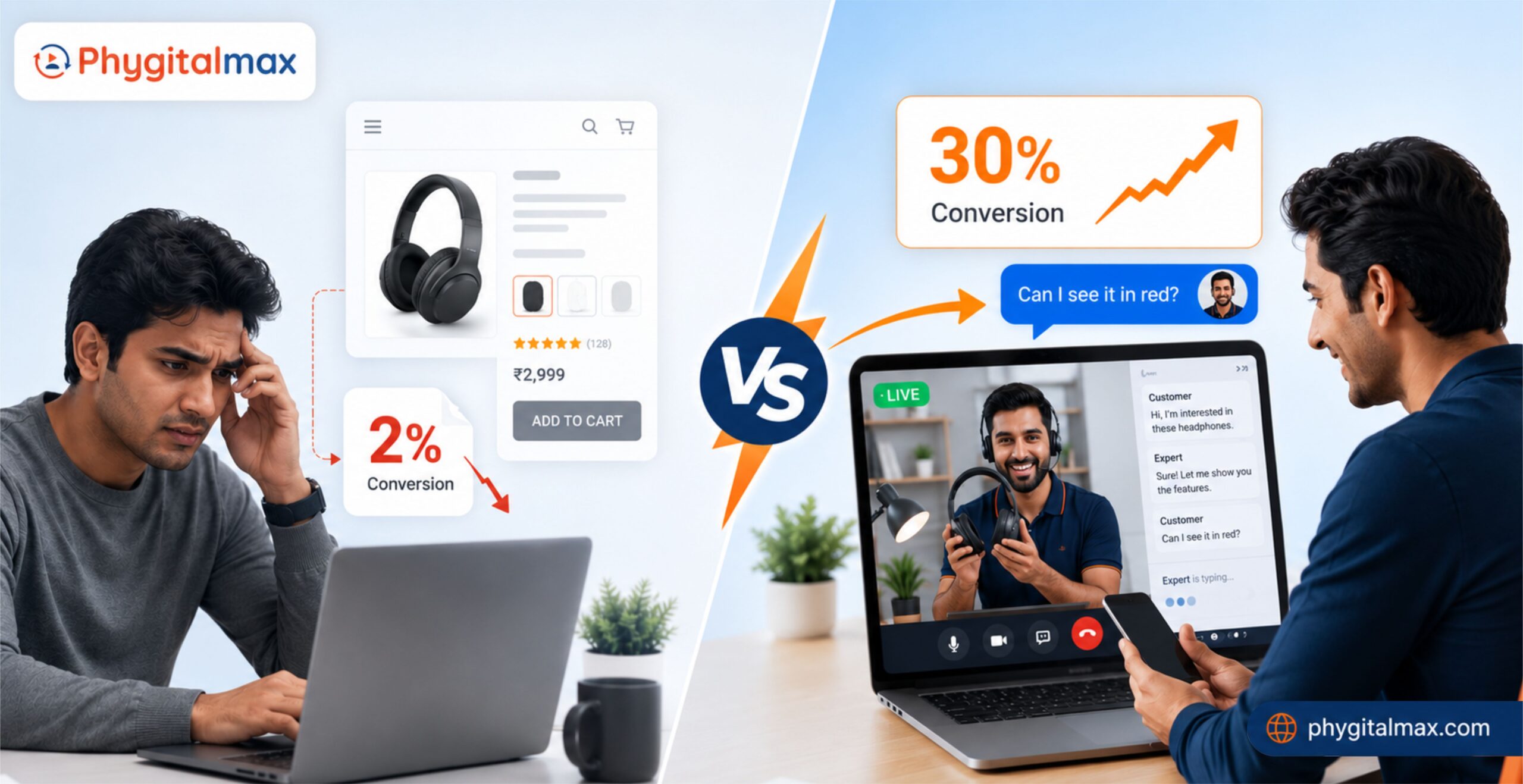
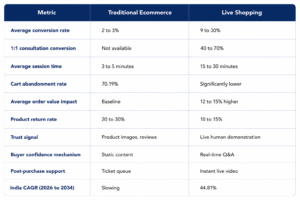
Traditional ecommerce converts at 2 to 3 percent globally. Live shopping converts at 9 to 30 percent. Same product. Same price. The only difference is the buying experience.
This guide breaks down the full head-to-head comparison so you can see exactly where the difference between live shopping and traditional ecommerce comes from, and what it means for your bottom line.
What Is Live Shopping?
Live shopping is a real-time video-based commerce format where shoppers watch product demonstrations, ask questions, and purchase without leaving the session. It operates in two modes:
1:1 Live Video Shopping: A one-on-one session between a single shopper and a product expert. Private, guided, and highly personalised. Conversion rates in this format reach 40 to 70 percent in premium categories.
1:Many Live Streaming: A host demonstrates products to multiple viewers simultaneously with embedded purchase options. Average conversion: 9 to 30 percent.
Both formats deliver what traditional ecommerce structurally cannot: a human being answering questions in real time, at the exact moment a shopper is considering a purchase.
Read more: How Live Video Shopping Bridges the Online-Offline Gap
Live Shopping vs Traditional Ecommerce: Head-to-Head
5 Areas Where Live Shopping Clearly Wins
1. Conversion Rate: Not Even Close
The core difference between live shopping and traditional ecommerce comes down to one structural gap: confidence.
Baymard Institute confirms the global cart abandonment rate is 70.19 percent. Shoppers do not abandon because the product is wrong. They abandon because they are uncertain, and no one is there to help them decide.
Live shopping removes that uncertainty in real time. Conversion rates for live shopping events reach 9 to 30 percent, compared to 2 to 3 percent for traditional ecommerce. In luxury and high-consideration categories, 1:1 live video sessions hit 70 percent. That is a 10 to 35 times improvement from the same product, sold differently.
Read more: How Live Video Commerce Converts Faster Than Traditional Ecommerce
2. Engagement: 6x More Time on Site
On a standard product page, the average shopper spends 3 to 5 minutes. During a live shopping session, they spend 15 to 30 minutes. That is not browsing time. That is buying time.
Live streams generate approximately 10 times more comments and interactions than pre-recorded video content. Active, engaged participants convert at 2 to 3 times the rate of passive viewers. The more invested a shopper becomes in a session, the more certain they are about their decision.
Traditional ecommerce has no equivalent mechanism. Product pages cannot respond. Reviews cannot answer new questions. Chatbots cannot demonstrate.
3. Average Order Value: 12 to 15% Higher
Live shopping does not just convert more buyers. It converts them to larger purchases.
Hosts who demonstrate complementary products, build bundles in real time, and explain upgrade logic see average order values rise 12 to 15 percent compared to standard online purchases. A shopper who came in for a single appliance leaves with the accessories and extended service plan, because a live expert explained why it made sense for their specific situation.
Traditional ecommerce relies on “frequently bought together” widgets and upsell pop-ups. These are static. They do not adapt to the individual shopper’s questions or hesitations. Live commerce does.
4. Returns: 40 Percent Fewer
Product returns are one of the highest hidden costs in ecommerce. The industry average sits at 20 to 30 percent. For fashion and electronics, it runs even higher.
Returns happen for one reason: mismatched expectations. A shopper imagined something different from what arrived. Live shoppers are approximately 40 percent less likely to return items compared to standard online shoppers. When a buyer has watched a real product demonstrated, confirmed fit and functionality through live Q&A, and seen it in a realistic setting, there is no expectation gap.
Read more: 5 Live Commerce Strategies That Instantly Improve Your Ecommerce Conversion Rate
5. Buyer Trust: Human vs Static
The single biggest difference between live shopping and traditional ecommerce is the trust signal.
Traditional ecommerce trust signals are all post-purchase: star ratings, written reviews, return policies. They tell the buyer what other people thought after buying. They do not resolve the buyer’s current question.
Live shopping trust signals are real-time: a human demonstrating the product, answering the exact question the buyer has right now, and standing behind the recommendation live. Research shows 78 percent of consumers report increased purchase likelihood when they feel personally connected to the host. For Indian online shoppers, where 68 percent cite trust as their primary purchase barrier, a live human is the most powerful conversion tool available.
Read more: Why 1:1 Live Video Is the Future of Online Shopping
Where Traditional Ecommerce Still Has a Role
Traditional ecommerce is not obsolete. It handles scale, catalog browsing, and repeat purchases from loyal customers efficiently. A buyer who already owns your product and knows exactly which replacement part they need does not require a live video session. They need a fast search and a smooth checkout.
The error is relying on traditional ecommerce for first-time, high-consideration, or high-value purchases. That is where the 70 percent abandonment rate lives. That is exactly where live shopping is designed to operate.
The winning approach is not live shopping or traditional ecommerce. It is both. Live commerce handles the uncertain, high-intent buyer. Traditional ecommerce handles the repeat, brand-loyal buyer. This combination is what PhygitalMax calls phygital commerce: the best of physical retail and digital convenience, available on the same product page.
Live Shopping in India: The Numbers Are Accelerating
India is not following the global live shopping curve. It is leading it.
The India live commerce market was valued at $7.04 billion in 2025 and is projected to grow at a CAGR of 44.81 percent through 2034. Fashion and apparel dominate with 29.3 percent market share. Social media platforms drive 52.6 percent of all live commerce discovery. Flipkart’s own data from mid-2025 showed over 200 million users engaging with video commerce in just the first half of the year, up from 75 million in the same period the year before.
For Indian D2C brands, FMCD manufacturers, jewelry retailers, and beauty brands, live shopping is not a future channel. It is an active, high-growth revenue channel right now.
Frequently Asked Questions
Q: What is the difference between live shopping and traditional ecommerce?
Traditional ecommerce is a static, self-service model where buyers browse product pages and make purchase decisions alone. Live shopping is an interactive, real-time model where buyers connect with product experts via live video, ask questions, see demonstrations, and purchase within the session. Live shopping converts at 9 to 30 percent versus 2 to 3 percent for traditional ecommerce, making it 5 to 10 times more effective for high-consideration purchases.
Q: What is live shopping and how does it work?
Live shopping connects a buyer with a brand expert through real-time video embedded on a brand’s website or app. The buyer can connect instantly for an immediate session or schedule one for a preferred time. During the session they explore the product live, ask any question, and complete the purchase within the video, with no redirect or friction.
Q: Why does live shopping convert better than traditional ecommerce?
Live shopping converts better because it resolves purchase uncertainty in real time. Traditional ecommerce forces buyers to make decisions alone using static content. Live shopping places a knowledgeable human at the exact moment of doubt, answering questions, demonstrating the product, and building the confidence needed to buy. This is why live shopping conversion rates are 5 to 10 times higher than standard product pages.
Q: Is live shopping growing in India?
Yes. India’s live commerce market is growing at 44.81 percent CAGR and was valued at over $7 billion in 2025. With 75 percent of Indian shoppers already having used live shopping and mobile commerce conversion rates lagging significantly behind desktop, live shopping is one of the highest-ROI channels for Indian brands in 2026.
Q: Does live shopping reduce product returns?
Yes. Live shoppers are approximately 40 percent less likely to return items compared to standard online shoppers. Real-time product demonstrations set accurate expectations before purchase, eliminating the expectation mismatch that drives most returns in traditional ecommerce.
Q: What is the difference between ecommerce and traditional commerce?
Traditional commerce is physical, in-store selling. Ecommerce is digital, self-service selling through websites and apps. Live shopping is a third model that combines both: the human guidance and trust of traditional commerce delivered through a digital channel. This combination, called phygital commerce, consistently outperforms both pure traditional commerce and standard ecommerce in conversion, engagement, and customer satisfaction.
Conclusion
The data does not leave room for debate. Live shopping wins on every metric that matters: conversion rate, engagement, average order value, return rate, and buyer trust.
Traditional ecommerce is not going away. But relying on it alone for high-consideration, first-time, or high-value purchases means accepting a 70 percent abandonment rate as the cost of doing business. Live shopping eliminates that cost.
PhygitalMax makes it straightforward. No platform migration, no tech overhaul. Live video commerce embedded directly on your existing product pages, with connect-now and schedule-later options giving every high-intent shopper a live commerce touchpoint, on their terms.
Ready to see how live shopping performs for your category? Book a live demo with PhygitalMax and see the platform in action.